publications
2026
- Sci. Rep.
 A Systematically Designed Open-Access Dataset for Cross-Microscope Machine Learning Benchmarking in Complex Steel Microstructure ClassificationBjörn-Ivo Bachmann, Marie Stiefel, Martin Müller, Camilo Martínez, Dominik Britz, and Frank MücklichScientific Reports (Nature Portfolio), Sep 2026
The establishment of robust machine learning workflows for microstructure analysis requires datasets that systematically capture the variance introduced by the imaging pipeline. While existing studies in this field predominantly rely on well-curated, homogeneous datasets optimized for high classification performance, these conditions rarely reflect the variance encountered in real-world settings. This work presents a publicly available, FAIR-compliant dataset of 5327 annotated micrograph patches, showing bainitic and martensitic microstructural constituents in quenched and quenched-and-tempered low-carbon steels, acquired on three different optical microscopes across two magnification levels (20x and 50x) and under deliberately varied acquisition conditions. Identical regions of interest were imaged on all platforms and aligned by image registration, enabling optimal comparability by pixel-wise alignment across instruments and magnifications. This correlative structure makes the dataset uniquely suited for systematic investigations of cross-instrument and cross-magnification domain generalization. Using this dataset, the influence of microscopy modality-induced domain shifts on the classification performance of deep convolutional neural networks was analyzed. A general model trained on the full dataset achieved near-perfect classification (F1 score of 99.91%), demonstrating that modern deep learning is capable of handling the full range of imaging-induced variance when sufficient data coverage is provided. Cross-domain experiments revealed that generalization is governed primarily by the physical fidelity of the input representation and the coverage of imaging-induced variance in the training data, rather than by model architecture or nominal magnification alone. The direction in which resolution gaps are bridged between training and validation domains proved more decisive than information density per se. Among single-instrument configurations, broad variation of acquisition conditions, such as aperture, exposure, and color temperature, contributed more effectively to cross-domain robustness than optical diversity between objective lenses alone. These results suggest that targeted variation of acquisition conditions, rather than purely morphological diversity, is a particularly effective strategy for improving model generalization. The dataset is released to the community as a benchmark resource for domain shift analysis, generative modeling, and domain-aware learning in microstructure-based machine learning.
@article{Bachmann_2026, title = {A Systematically Designed Open-Access Dataset for Cross-Microscope Machine Learning Benchmarking in Complex Steel Microstructure Classification}, volume = {16}, issn = {2045-2322}, url = {http://dx.doi.org/10.1038/s41598-026-73141-2}, doi = {10.1038/s41598-026-73141-2}, journal = {Scientific Reports}, publisher = {Springer Science and Business Media LLC}, author = {Bachmann, Björn-Ivo and Stiefel, Marie and Müller, Martin and Martínez, Camilo and Britz, Dominik and Mücklich, Frank}, year = {2026}, month = sep, pages = {29853}, } - Discov. Mech. Eng.
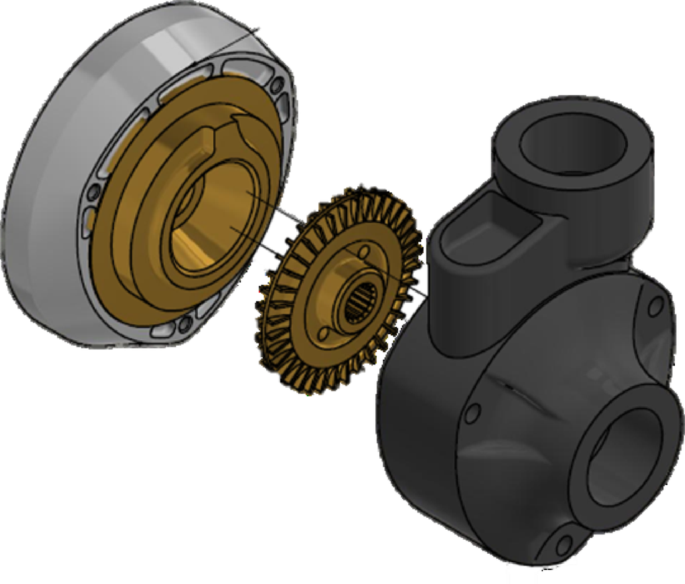 Numerical Study of Regenerative Pump Characteristics Operating under Different Fluid Viscosities and Multistage ArrangementLaura Peña, Flor Calderon, Camilo Martínez, Jennifer Páez, Miguel Asuaje, Omar Lopez, and Nicolas RatkovichDiscover Mechanical Engineering (Springer Nature), Jan 2026
Regenerative (peripheral) pumps offer compact, high-head solutions for low-flow applications; however, reliable performance data for viscous fluids and multistage configurations remain limited. This study employs high-fidelity geometry reconstruction and mesh-refined Computational Fluid Dynamics (CFD) to examine how fluid viscosity and stage number jointly influence the hydraulic performance of a commercial Pedrollo PKm60 pump. A laser scan of the impeller and side channel eliminated CAD simplifications and, together with a grid-convergence study, reduced the root-mean-square error between predicted and catalog heads to 1.71 m (5.8%). Simulations were performed using steady Reynolds-averaged Navier–Stokes (RANS) equations with a moving reference frame (MRF) formulation and the Realizable k–ε turbulence model. A single transient unsteady RANS (URANS) verification case with the SST k–ω model at Q = 10 L min−1 underpredicted the head (29.28 m) compared to the steady result (31.70 m) and manufacturer data (33.356 m). Because the steady solution matched the reference solution more closely, steady RANS (MRF) was adopted for all performance maps and analyses. Increasing viscosity shifted the best-efficiency point (BEP) from 23 to 17 L min−1 and reduced peak hydraulic efficiency from 34 to 20%. In the multistage configuration, the normalized head rose by 18% from Stage 1 to Stage 3, while power input increased by less than 5%, indicating efficient head development with diminishing internal losses. Flow visualizations of streamlines, turbulent kinetic energy, and pressure gradients revealed vortex suppression and boundary-layer thickening as the dominant mechanisms governing these performance changes. The resulting dimensionless correlations and validated flow-field data provide practical guidance for selecting and scaling regenerative pumps for handling viscous liquids, supporting Sustainable Development Goal 9 through energy-efficient, resource-conscious industrial fluid-handling design.
@article{Pena_2026,
  title = {Numerical Study of Regenerative Pump Characteristics Operating under Different Fluid Viscosities and Multistage Arrangement},
  volume = {5},
  issn = {2731-6564},
  url = {http://dx.doi.org/10.1007/s44245-025-00170-y},
  doi = {10.1007/s44245-025-00170-y},
  journal = {Discover Mechanical Engineering},
  publisher = {Springer Science and Business Media LLC},
  author = {Peña, Laura and Calderon, Flor and Martínez, Camilo and Páez, Jennifer and Asuaje, Miguel and Lopez, Omar and Ratkovich, Nicolas},
  year = {2026},
  month = jan,
  pages = {4},
}
2024
- ICMI
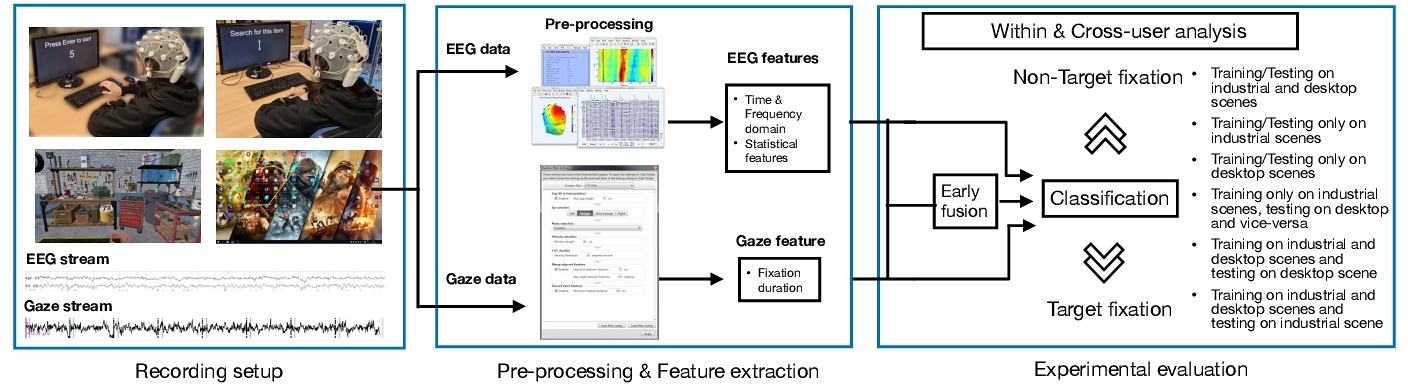 Distinguishing Target and Non-Target Fixations with EEG and Eye Tracking in Realistic Visual ScenesMansi Sharma, Camilo Martínez, Benedikt Emanuel Wirth, Antonio Krüger, and Philipp MüllerIn Proceedings of the 26th International Conference on Multimodal Interaction, Nov 2024
Distinguishing target from non-target fixations during visual search is a fundamental building block to understand users’ intended actions and to build effective assistance systems. While prior research indicated the feasibility of classifying target vs. non-target fixations based on eye tracking and electroencephalography (EEG) data, these studies were conducted with explicitly instructed search trajectories, abstract visual stimuli, and disregarded any scene context. This is in stark contrast with the fact that human visual search is largely driven by scene characteristics and raises questions regarding generalizability to more realistic scenarios. To close this gap, we, for the first time, investigate the classification of target vs. non-target fixations during free visual search in realistic scenes. In particular, we conducted a 36-participants user study using a large variety of 140 realistic visual search scenes in two highly relevant application scenarios: searching for icons on desktop backgrounds and finding tools in a cluttered workshop. Our approach based on gaze and EEG features outperforms the previous state-of-the-art approach based on a combination of fixation duration and saccade-related potentials. We perform extensive evaluations to assess the generalizability of our approach across scene types. Our approach significantly advances the ability to distinguish between target and non-target fixations in realistic scenarios, achieving 83.6% accuracy in cross-user evaluations. This substantially outperforms previous methods based on saccade-related potentials, which reached only 56.9% accuracy.
@inproceedings{Sharma_2024,
  series = {ICMI ’24},
  title = {Distinguishing Target and Non-Target Fixations with EEG and Eye Tracking in Realistic Visual Scenes},
  url = {http://dx.doi.org/10.1145/3678957.3685728},
  doi = {10.1145/3678957.3685728},
  booktitle = {Proceedings of the 26th International Conference on Multimodal Interaction},
  publisher = {ACM},
  address = {New York, NY, USA},
  isbn = {979-8-4007-0462-8},
  author = {Sharma, Mansi and Martínez, Camilo and Wirth, Benedikt Emanuel and Krüger, Antonio and Müller, Philipp},
  year = {2024},
  month = nov,
  pages = {459--468},
}
2021
- B.Sc. Thesis
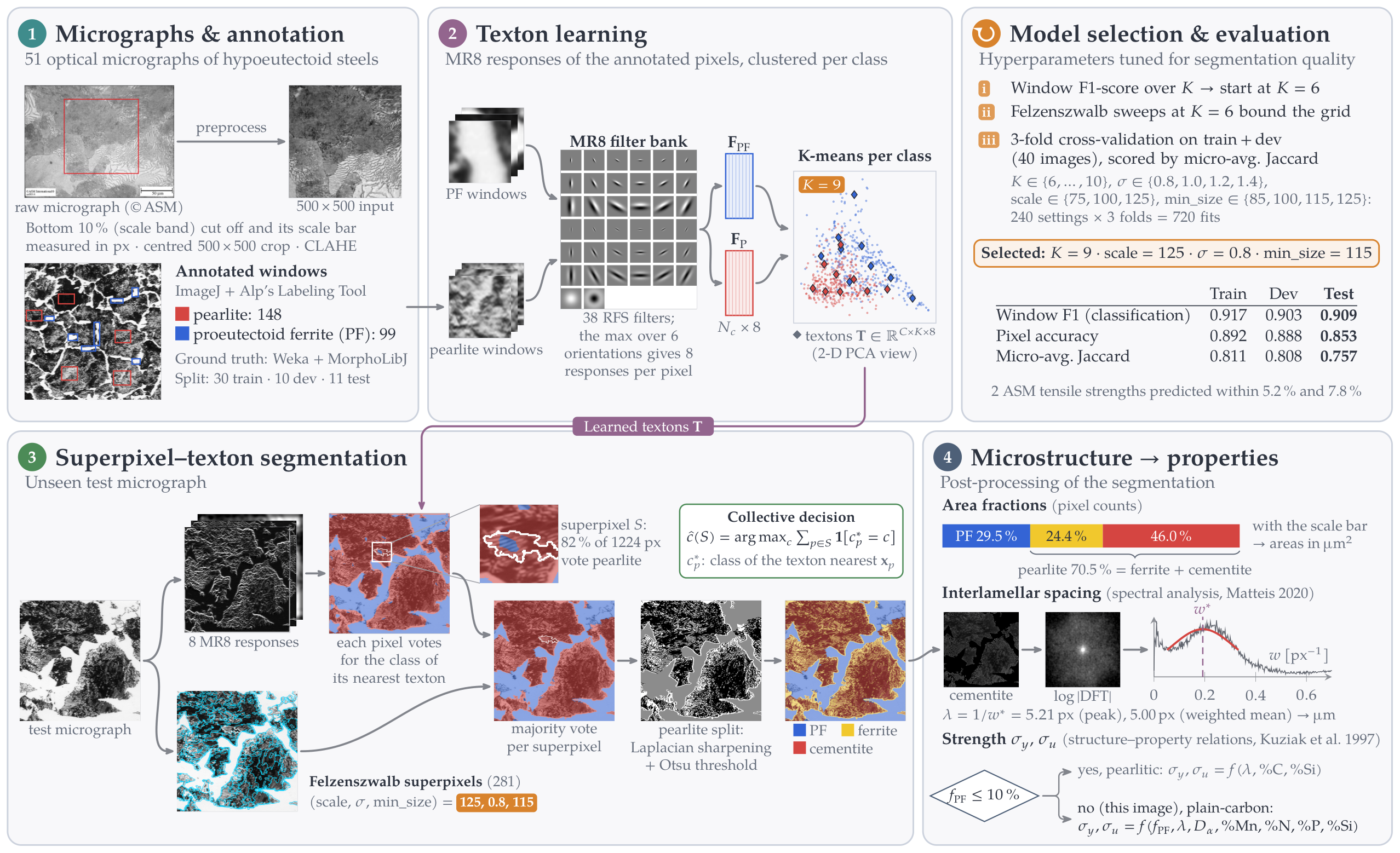 Application of Computer Vision in the Analysis of Microstructures and Obtaining Structure-Property RelationshipsCamilo MartínezUniversidad de los Andes, Feb 2021Bachelor’s thesis
Manual identification, classification, and segmentation of micrographs is a complex and time-consuming task, even for experts in materials science. With the advancement of computers as well as the emergence of increasingly accurate and robust machine learning algorithms, there has been a growing interest from the scientific community in introducing these new approaches to a science known to be highly empirical. In this context and in order to contribute to this topic, a supervised machine learning model was implemented in this study for the segmentation of pearlite and ferrite in hypoeutectoid steels. For its training, the texture of the regions of interest was used as the distinguishing feature between them. The trained algorithm was then applied to the validation and test data set, evaluating both its classification and segmentation performance, with statistical metrics commonly used in segmentation, such as the confusion matrix, F1-score and Jaccard index. In this way, a supervised machine learning model was obtained, capable of segmenting hypoeutectoid steels and calculating the volume fraction of the proeutectoid ferrite and pearlite. Later, in a post-processing step of the micrographs and using the segmentation produced by the model, it was possible to estimate the mean apparent interlaminar spacing of the pearlite, which together with the volume fractions of the phases present allowed to predict the mechanical properties of the material associated with the micrograph. These predictions were compared with values reported by the ASM for some micrographs and it was found that, in general, they were very consistent. The final performance of the model was 75.7% in Micro Averaged Jaccard Index; and 85.3% in accuracy. These values are comparable with those reported by segmentation models reviewed in the literature.
@mastersthesis{Martinez_2021,
  title = {Application of Computer Vision in the Analysis of Microstructures and Obtaining Structure-Property Relationships},
  author = {Martínez, Camilo},
  school = {Universidad de los Andes},
  year = {2021},
  month = feb,
  note = {Bachelor's thesis},
  url = {http://hdl.handle.net/1992/51616},
}